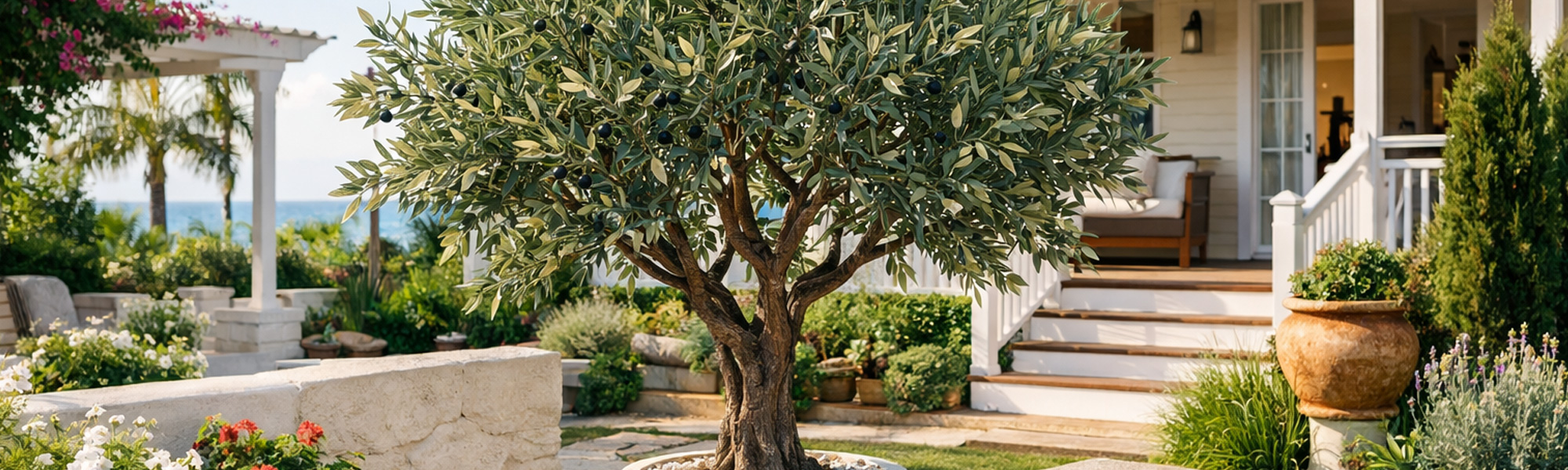
Outdoor artificial plants used to be associated with obviously fake greenery pushed into harsh corners, faded by the sun, stiff in the wind and chosen mainly because nothing else would survive there. That image no longer captures the best of what the category has become. The stronger products now are designed with better leaf patterning, more natural variation in colour, more convincing branching and far better awareness of how plants are actually used in exterior design. In practical terms, that means they are no longer just substitutes for neglected garden beds. They are increasingly part of the way people finish balconies, courtyards, entry zones, pool surrounds, roof terraces, apartment patios, commercial forecourts and difficult transition spaces where the look of greenery matters every day but the conditions for maintaining real planting are inconsistent, expensive or impractical.
That shift makes sense because outdoor styling has become more ambitious. People want exterior spaces to feel composed and liveable, not merely serviceable. They want a small apartment balcony to feel calm and private. They want a front entry to look settled. They want a rooftop terrace to feel softened rather than hard and exposed. They want screening around utilities, sharper presentation around pools, and greenery in places where irrigation, drainage, access, weight limits or maintenance schedules make living plants complicated. Outdoor artificial plants answer that brief with a kind of reliability that real planting cannot always match. They keep their volume, they do not suddenly collapse after a missed watering cycle, and they can deliver greenery in spots where reflected heat, wind exposure, salt air, narrow planters or inconsistent occupancy make horticultural success uncertain. The result is not a replacement for the garden as a living system. It is a design tool for creating shape, softness and privacy in places where a predictable visual outcome matters.
The Real Appeal Is Consistency, Not Deception
The most useful way to understand outdoor artificial plants is to stop judging them by whether they can completely fool a person standing twenty centimetres away. That is not the standard by which exterior spaces are actually experienced. Most people read an outdoor area from across a courtyard, through a sliding door, from the driveway, from a seating zone, or as part of a broader composition of paving, walls, fencing, outdoor furniture and light. At that distance, what matters most is silhouette, scale, softness, colour balance and how the planting helps resolve the space. A good artificial hedge panel can make a fence line feel quieter. A cluster of artificial grasses can break up hard paving. A well-chosen potted faux olive or tropical form can complete an entry or pool corner. A trailing plant can soften a balcony balustrade. These are compositional roles, and in those roles artificial plants can work very well.
Consistency is the deeper reason people choose them. Outdoor areas are often harder to maintain than interior rooms because they are exposed to sunlight, wind, rain, dust and debris, and because people typically spend less time fussing over them day to day. A real plant in a difficult balcony corner may look good for a few weeks, then sparse, stressed or scorched. A screening hedge in a narrow planter may begin strongly and then become uneven because watering, nutrition, root room and drainage were never quite right. Artificial plants remove a great deal of that volatility. The screening stays dense. The shape stays full. The planter stays tidy. The outdoor room keeps its intended look. That stable quality is one reason they have become appealing not only in homes but also in commercial settings, display spaces and hospitality environments where presentation needs to remain composed regardless of weather or maintenance gaps.
Why They Suit So Many Modern Outdoor Spaces
Modern outdoor areas often ask for greenery in places that are visually important but physically difficult. Apartment balconies may have intense sun, strong wind and strict weight limits. Small courtyards may be heavily paved and heat reflective. Rooftop spaces may have exposure from every angle. Pool zones often involve splash, glare and hardscape surfaces that magnify heat. Front entries may be narrow, enclosed or used mainly for presentation rather than gardening. Outdoor kitchens and entertainment areas can benefit from greenery, but the planting positions available may not suit healthy growth for real species. In all of these cases, the desire for softness and enclosure remains strong even when the horticultural conditions are poor.
That is where outdoor artificial plants find a very practical role. They let a space carry the visual language of planting without demanding the root depth, irrigation, fertiliser, pest monitoring, pruning routine and light conditions that real planting would need. They can also be useful in properties that are not occupied continuously, such as holiday homes, city apartments used part time, or houses where the owners travel frequently. A balcony or courtyard can still look finished on arrival rather than tired, patchy or half dead. In property presentation, they help exterior photographs and inspections feel more generous and more settled. In commercial settings, they help maintain a polished exterior even where the upkeep of live planting would be labour intensive or unreliable. Their rise is tied closely to the way exterior living has become more design driven and more image conscious.
The Sun Changes Everything Outdoors
The single biggest difference between indoor and outdoor artificial plants is the sun. Outdoors, synthetic materials are exposed to a combination of ultraviolet radiation, heat, air and moisture, and research on plastics is clear that outdoor weathering can drive physical and chemical deterioration over time. Studies of weathering in plastics describe sunlight, heat, air and moisture as a damaging combination, while conservation guidance also notes that light and ultraviolet exposure can weaken, embrittle, crack, yellow or fade vulnerable materials. Australia adds another layer to that challenge because ultraviolet levels are exceptionally high, and sun safety guidance notes that the country experiences some of the highest ultraviolet radiation levels in the world, with sun protection recommended when ultraviolet levels reach 3 or above.
That does not mean outdoor artificial plants are a bad idea. It means buyers have to understand that not all faux greenery is built for exterior use, and that ultraviolet resistance is not a throwaway marketing detail. It is central to performance. A cheap indoor-grade faux plant placed outside in full Australian sun is likely to age quickly. The green may flatten into a dull grey tone. Leaves may become brittle. Surfaces may chalk or lose their finish. Branches may begin to look tired long before the shape actually fails. Better outdoor products are designed specifically for that environment, using materials and stabilisers intended to slow the impact of ultraviolet light and weather. Even then, the amount of exposure matters. A covered alfresco edge is not the same as an unshaded western balcony or a rooftop that receives hard sun for most of the day. Outdoor artificial greenery works best when product quality and site conditions are considered together rather than separately.
Not Every Outdoor Artificial Plant Is Truly Outdoor Grade
One of the most common mistakes is assuming that any artificial plant can be used outdoors if it looks robust enough. In reality, outdoor suitability depends on far more than visual thickness or a slightly tougher feel. Exterior use asks a material to withstand ultraviolet exposure, temperature swings, moisture, dust and sometimes wind-driven movement. Products that are not built for those conditions can decline quickly even if they looked promising on the day they arrived. That is why it is worth treating the words outdoor suitable, ultraviolet resistant and weather resistant as practical buying criteria rather than decorative marketing language.
The stronger outdoor artificial plants usually show their quality in a few ways. Their colour tends to be more natural and more stable, rather than aggressively bright. Their leaves often have a matte or restrained finish rather than a plastic shine. Their stems and branch structures feel more deliberate. Their assembly points are usually less clumsy. Their foliage mass is full without looking swollen or uniform. They also tend to make more sense from a distance, which is where outdoor planting is typically experienced. A good exterior faux plant should still look credible in morning light, in hard afternoon sun and in shadow, and it should not rely on one flattering indoor-style angle. Buying fewer better pieces is usually the wiser approach, because poor outdoor artificial plants can age a space quickly. Good ones, by contrast, can make difficult areas feel instantly more finished.
Where Outdoor Artificial Plants Work Best
Some exterior locations suit artificial plants especially well. Balconies are high on that list because they often need softness and privacy but do not always offer ideal growing conditions. A line of faux screening, a tall planter with a convincing upright plant, or a cluster of textured greenery can turn a hard-edged balcony into something calmer and more enclosed. Courtyards are another strong setting, especially where high walls, paving and reflected heat make live plants harder to sustain. Artificial greenery can soften masonry, add height where sightlines need screening, and make the space feel less exposed from the house.
Entry zones also benefit. A pair of properly scaled outdoor faux plants can help a front door feel anchored and more welcoming, particularly in homes where the architectural lines are crisp and the landscaping is intentionally restrained. Pool areas can suit artificial greenery when the goal is visual softness near seating or feature walls rather than a planting bed that drops leaves into the water or struggles with splash and glare. Rooftop entertaining areas, apartment terraces, commercial forecourts, café boundaries and narrow service-side transitions can also benefit because the need for year-round presentation is often higher than the appetite for constant garden maintenance. The common thread is simple. These are spaces where greenery is visually valuable and growing conditions or maintenance patterns are less cooperative.
Screening and Privacy Are One of the Biggest Reasons People Use Them
Outdoor artificial plants are often at their most useful when they are employed for screening rather than for botanical imitation. Privacy is one of the strongest drivers of exterior design, particularly in apartments, townhouses and contemporary suburban homes where boundaries are close and outdoor rooms are increasingly important. A balcony may need to feel separated from neighbouring sightlines. A patio may need to soften a fence without rebuilding it. A utility area may need to be concealed more attractively. A pool pump zone, bin area or service wall may benefit from a greener face. In these cases, the aim is less about pretending the screen is a living hedge and more about creating a softer, more attractive visual barrier.
This is why hedge panels, artificial green walls and dense faux planting strips have grown in popularity. They offer immediate cover, stable density and a cleaner result than waiting years for a living hedge to fill in, especially where planter depth is limited. Used well, they can also help with the psychological feel of a space. Hard boundaries become less harsh. Views become more filtered. The outdoor room feels more private and more deliberate. The best results come when the screen is integrated thoughtfully, with proper support, believable layering and enough surrounding material quality that the greenery feels intentional rather than tacked on.
Potting and Framing Matter Outdoors Even More Than Indoors
A convincing outdoor artificial plant depends heavily on what surrounds it. The pot, planter box, basket, trough or built-in joinery element carries a large share of the illusion. Outdoors, that effect is even stronger because exterior spaces are read quickly and materially. If the plant sits in a flimsy vessel that does not suit the scale of the home, it will rarely look settled. If the planter is too small, too light or too decorative in the wrong way, the whole arrangement can feel temporary. A much better result usually comes from substantial planters that match the architecture of the house or outdoor area. Stone-look vessels, textured concrete planters, powder-coated metal troughs, timber-clad boxes or well-chosen ceramics can all help the planting feel grounded.
Top dressing also matters. Artificial moss that looks too bright, highly decorative pebbles that have no relationship to the space, or visible plastic anchors can spoil the effect immediately. More restrained surface finishes usually work better. A muted gravel layer, bark-like cover, concealed fill or carefully chosen stone can make the arrangement feel far more natural. Weight is another practical issue. Outdoor planters need enough stability to cope with wind, accidental knocks and visual plausibility. A tall faux plant wobbling in a lightweight pot rarely feels resolved. A grounded arrangement, by contrast, reads as architecture as much as decoration.
Wind Exposure Is Often More Important Than Buyers Expect
Many people think first about sun and rain but underestimate the effect of wind. Outdoor artificial plants may not need water, but they still need to sit comfortably in the physical conditions of the site. A windy balcony can turn large leaves into sails. A rooftop can create constant movement that stresses joinery points and rubs foliage against walls or railings. A narrow side yard can funnel gusts through a cluster of tall faux grasses until they look permanently pushed in one direction. Even where the plant itself survives, repeated wind movement can reduce realism because the foliage starts to sit unnaturally or abrade against nearby surfaces.
That does not rule out artificial plants in windy locations. It simply changes what works best. More compact shapes often perform better than broad, floppy forms. Secure installation matters. Dense screening fixed properly can be more successful than freestanding tall planters in very exposed sites. Pot weight, anchor method and foliage profile all become part of the decision. Outdoor artificial greenery should not only suit the look of the space. It should suit the behaviour of the space. A calm sheltered courtyard and a high exposed balcony are two entirely different design situations even if their floor area is similar.
Rain, Moisture and Dirt Still Matter
People often choose outdoor artificial plants because they want to avoid horticultural maintenance, and that is fair, but it is still useful to recognise that exterior faux greenery has a maintenance life of its own. Rainwater, dust, airborne grime, leaf litter, cobwebs and urban residue can all collect on synthetic foliage. Outdoors, dirt rarely settles as politely as it does inside. It can bake on, get trapped in textured leaves, or combine with moisture to make the greenery look flat and tired. Regular upkeep matters not because the plant is alive, but because realism depends heavily on freshness of finish.
The good news is that cleaning is usually simpler than caring for live plants. Most outdoor artificial greenery benefits from occasional rinsing, gentle wiping or light brushing, depending on its construction and where it is installed. Conservation guidance for plastics notes that dust is abrasive and that regular housekeeping helps preserve surfaces. That principle applies neatly outdoors, where accumulated grime can age synthetic foliage visually long before the structure itself fails. A quick periodic clean is often enough to keep the leaves clearer in tone and the overall arrangement more convincing.
Why Quality Shows So Clearly Outdoors
Inferior artificial plants can sometimes hide indoors for a while, especially in dimmer rooms or styled corners. Outdoors, the environment is less forgiving. Sunlight reveals surface shine. Shadow reveals poor leaf patterning. Movement reveals weak structure. Water and dust expose low-quality finishes. Because of that, quality outdoors becomes more visible much more quickly. Cheap artificial greenery often suffers from repetitive leaf shapes, flat colour, toy-like gloss and exaggerated greenness that becomes even less believable under real daylight. Better pieces usually use more variation in tone, more natural spacing, a subtler surface finish and branch architecture that makes sense from multiple angles.
This matters because exterior spaces are often larger in scale than interior styling moments. A faux plant outside is rarely experienced alone. It sits beside paving, fencing, rendered walls, outdoor furniture and natural light. If it looks synthetic in an obvious way, the entire space can feel less refined. But if the foliage is restrained, the shape suits the location and the installation is solid, artificial greenery can make the whole outdoor setting feel more composed. In many cases, success comes down to moderation. One or two convincing elements can lift a space more effectively than trying to create an entire fake garden.
Outdoor Artificial Plants and Australian Conditions
Australian conditions make exterior plant choices especially revealing. Sun can be intense, air can be dry, rain can arrive hard, and many homes use large areas of paving, rendered surfaces, metal fencing and glazing that intensify reflected heat. In coastal areas, salt air adds another challenge. In subtropical Queensland, humidity and storms mix with strong ultraviolet exposure and long bright periods. These conditions can be difficult enough for real planting, let alone for synthetic materials that are not properly specified. That is why outdoor artificial plants in Australia should be chosen with realism about exposure, not optimism about product labels.
At the same time, these very conditions are part of why exterior faux greenery appeals. Many Australian outdoor spaces are designed to be used often and seen constantly. An alfresco area is not an afterthought. A pool terrace, patio or balcony is part of daily life. The pressure for that space to look pleasant and settled is therefore higher. Artificial plants can help deliver that consistency, especially where harsh exposure would make living plants look uneven or stressed without constant care. In subtropical design schemes, they can also help extend the visual language of planting into awkward corners, walls and screening zones where the architecture wants softness but the site does not cooperate.
Fire Considerations Should Not Be Ignored
Artificial greenery may look botanical, but it remains a manufactured decorative material, and that means fire performance matters. Fire safety guidance and code material note that combustible artificial decorative vegetation should meet relevant fire performance requirements, and code language also warns against open flames on or near combustible artificial decorative vegetation. In practical terms, that means exterior faux plants should not be treated as harmless simply because they resemble foliage. Around homes and commercial spaces alike, they should be kept away from open flames, hot light fittings, barbecues, heaters and other ignition sources unless the product has a verified fire-resistant specification appropriate to the setting.
This becomes even more important in hospitality areas, apartment common spaces, commercial fitouts and other projects where compliance obligations are higher. In those contexts, buyers should be looking not for vague reassurance but for actual testing information relevant to the jurisdiction and application. Even in ordinary residential use, common sense still applies. A faux screening wall beside a barbecue or decorative greenery wrapped around a heat source is not a styling shortcut worth taking. Outdoor artificial plants work best when they are treated as durable design materials with real physical properties, not as neutral ornaments.
They Are Not a Replacement for Good Landscape Design
Outdoor artificial plants can be very useful, but they are not a shortcut around every exterior design problem. They do not replace shade, soil health, cooling, biodiversity, drainage strategy or the emotional richness of a real garden. They do not create habitat in the same way living plants do. They do not change with the seasons, flush with new growth or carry the subtle irregularity that makes real planting so satisfying. Used indiscriminately, they can flatten a space into something that feels too static. Used thoughtfully, however, they can support a broader landscape scheme by solving very specific visual and practical problems.
That distinction matters. The strongest outdoor designs often use artificial greenery selectively rather than universally. A home might have a real garden in the main yard, living trees at the boundary, and then artificial screening on a difficult upper balcony. A courtyard might feature real planting in the ground but use faux elements to soften a wall where irrigation and light are poor. A commercial terrace might combine real planter beds with artificial infill in sections where maintenance access is limited. This mixed approach tends to feel more intelligent because it uses each material for what it does best. Living plants provide life, variation and ecology. Artificial plants provide stability, coverage and presentation in the harder spots.
Making Them Look Better Outside
Outdoor artificial plants look best when the installation is disciplined. Good scale is essential. A tiny faux plant in a large courtyard often looks apologetic. A very large one in a narrow balcony can feel theatrical. Proportion should respond to the volume of the space, the surrounding architecture and the viewing distance. Layering also helps. A single flat panel of greenery can look obviously decorative if it is unsupported by any other texture or depth. But when faux planting is combined with planter mass, timber, stone, screening battens or real surrounding materials, it becomes far more convincing.
Editing is just as important. Exterior spaces often benefit from fewer stronger elements rather than too many competing ones. Repetition can help where privacy screens or planter runs need continuity, but too many different faux species in one small area can make the result look restless. Colour should also be restrained. Slightly dustier greens, olive tones and natural variation usually feel better outdoors than very bright plastic greens. If the plant arrives tightly packed, shaping it carefully matters. Leaves and branches should be opened so the silhouette looks more natural and less compressed. These small decisions often determine whether the space feels polished or obviously artificial.
When Outdoor Artificial Plants Are the Smart Choice
They are the smart choice when a space needs dependable greenery but does not reliably support plant care. They are especially useful where access is difficult, where the occupants are not always present, where exposure is severe, where privacy is urgent, or where the design outcome needs to remain stable through inspections, entertaining or commercial operation. They can also make sense where the cost of repeated plant replacement has become frustrating. A balcony that burns through real plants every season is not necessarily proving a moral point about authenticity. It may simply be telling you that the site is hostile and that another solution is needed.
They are also a strong choice when the desired role is essentially architectural. If the planting is there to screen, soften, define an edge or fill a visual gap, artificial greenery can perform that role with clarity. In those situations, the question is not whether it can replicate a living garden perfectly. It is whether it makes the space function and feel better. Very often, the answer is yes.
When Real Plants Are Still Better
Real plants remain the better option when growing conditions are good and the pleasure of living greenery is part of what the space is meant to offer. A generous garden bed, a sunny courtyard with irrigation, a pool edge with suitable species, or a front landscape designed for long-term establishment will usually benefit more from real planting. Living plants bring movement, seasonal change, habitat value and the quiet complexity that only real growth creates. Where that can be sustained well, it usually adds a depth that artificial materials do not fully replicate.
The most useful mindset, then, is not to frame the choice as a contest between authenticity and convenience. It is to ask which parts of the property truly want living landscape, and which parts simply need dependable greenery to complete the design. Once that distinction is made, the decision becomes much easier and much more practical.
Outdoor artificial plants have earned their place because exterior spaces now ask for more than they once did. They are expected to feel private, softened, styled and ready to use, often in conditions that are windy, hot, exposed, weight-limited or simply awkward for real planting. Artificial greenery answers that demand with stability. It can complete a balcony, calm a courtyard, sharpen an entry, screen a boundary and make a hard exterior feel more generous. The key is choosing outdoor-grade products, respecting the site’s exposure, keeping fire safety in mind and using them with enough restraint that they support the architecture rather than overwhelm it.
When that is done well, outdoor artificial plants do not feel like a compromise. They feel like a practical design decision that understands how people actually live outside now.
You might also like


Disclaimer: Every effort has been made to ensure the accuracy of the information provided, but we make no guarantees regarding its completeness or reliability. The data is presented for general informational purposes only and does not constitute financial, investment, or legal advice. We are not liable for any errors, omissions, or consequences arising from its use. Users should verify details with relevant sources and seek professional advice where appropriate for the most accurate and up-to-date guidance.


